WoundScribe on Wheels
The wound care platform that doesn’t stop when your clinicians start driving.
Mobile wound care runs on windshield time, a different EHR at every facility, and charting from the driver’s seat at 9 pm. On Wheels collapses 2–3 hours of daily documentation into minutes — returning 3–4 patient slots to every clinician, every day.
A DAY IN THE FIELD — TRANSFORMED
From first bedside to last mile, AI rides along



Walking out — the chart writes itself
SOAP note, nurse note, procedure note, and codes drafted before you reach the parking lot. Review, sign, next patient.
01
At the bedside — capture everything in one pass
Point-n-Capture™ measures the wound; ambient AI records the encounter. By the time the dressing is on, the documentation already exists.
02
End of day — go home, actually
No charting backlog. Healing trajectories updated across the census. Patients and facility staff are supported by Pingoo between your visits.
03
On the road — the office runs without you
Notes flow to each facility's EHR in its own format. Offline captures queue and sync automatically. Windshield time stops being unpaid documentation debt.
04
WE UNDERSTAND MOBILE WOUND CARE, BECAUSE...
We invented it.
Dr. Desmond Bell founded the first mobile wound care service in the United States in 2003. Twenty years of facility rounds, trunk inventories, and midnight charting are built into every screen of this platform
Every documentation system mobile clinicians use today was designed for someone sitting still. Drop one into a car between SNFs, and the cracks show: a different portal at every stop, no signal in the basement wing, notes from visit three written from memory at visit nine.
On Wheels was built the other way around — starting from the trunk of the car.
SOUND FAMILIAR ?
The five-time thieves inside every mobile practice
Are your clinicians documenting 2–3 hours after the last visit?
Every visit generates a note, a wound record, codes, and facility paperwork. Done by hand after a 10-stop day, it's the single biggest driver of burnout — and turnover — in mobile wound care.
Is every facility a different portal, login, and workflow?
PointClickCare here, MatrixCare there, paper at the third stop. WoundScribe captures once and formats for each destination — your clinicians learn one workflow, not nine.
Does documentation die where the signal does?
SNF basements and rural routes don't care about your cloud. On Wheels captures fully offline — photos, ambient audio, measurements — and syncs when signal returns.
Is rushed coding leaving money in the chart?
Under-coded complexity and missed add-on procedures are the silent tax on every mobile practice. Coding & Billing AI suggests what rushed, end-of-day charting routinely loses.
Does growing mean hiring — or just burning out the team you have?
When documentation caps each clinician at a fixed daily census, the only growth lever is headcount. Collapse the overhead and each clinician sees 3–4 more patients per day — 30–40% revenue growth with the team you already trust.
Is every stop on the route a separate liability?
Mobile wound care crosses facility lines, payer types, and documentation standards in a single day. One missed LCD requirement, one unsigned order, one undocumented qualifying finding — and the claim that looked clean fails on audit. WoundScribe checks compliance at the point of care, stop by stop, before the van reaches the next address.
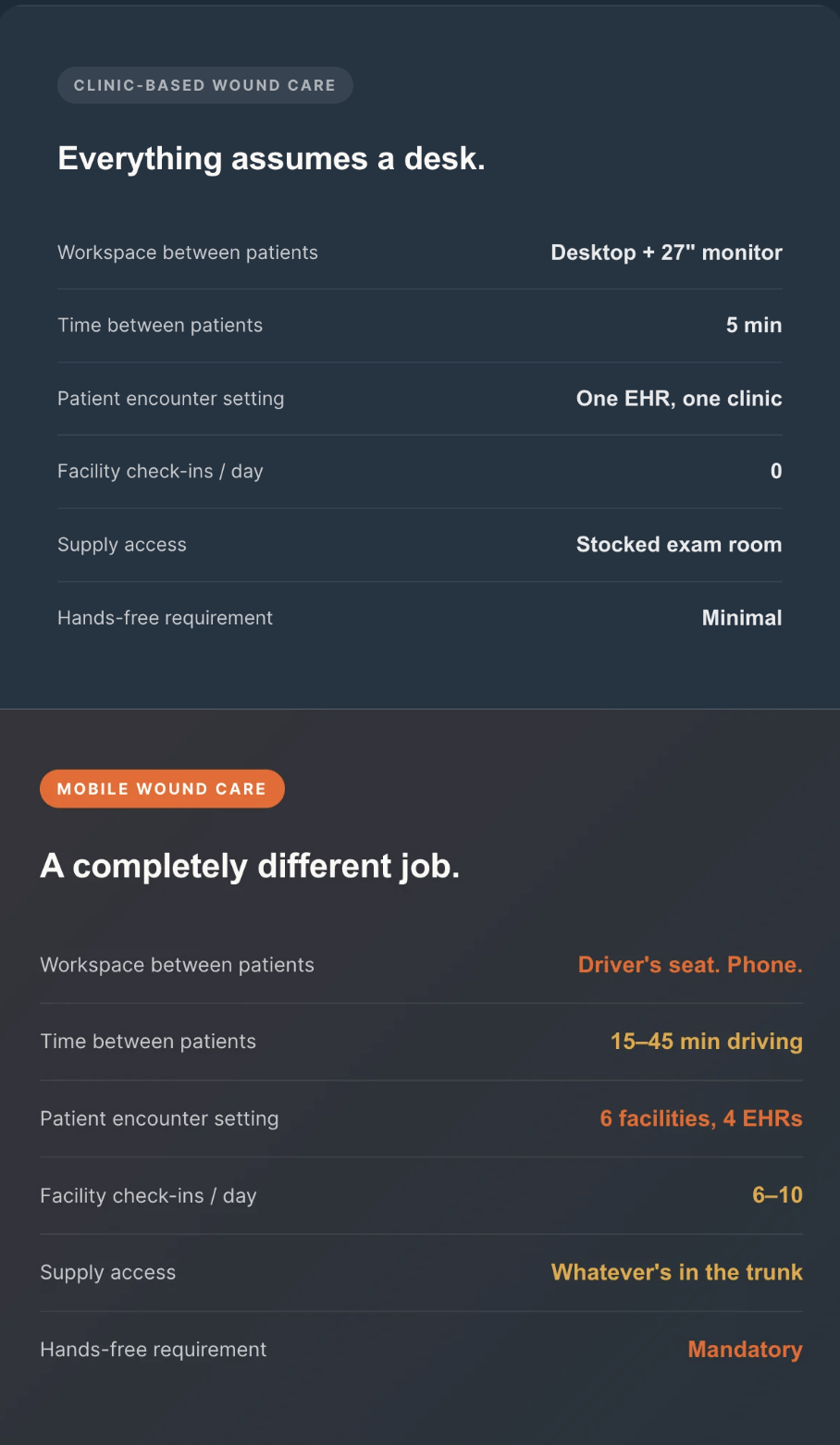
We understand the challenges of mobile wound care, because…
We have been there, done that!
Every platform in wound care today was designed for a desk.
Drop it into a minivan, and the cracks show immediately: workflows that assume a keyboard, documentation that assumes Wi-Fi, coding that assumes a billing team down the hall.
WoundScribe on Wheels was built the other way around — starting from the driver's seat, the phone, the six facilities, and the four EHRs — by clinicians who spent years doing exactly what your team does now.
By Numbers
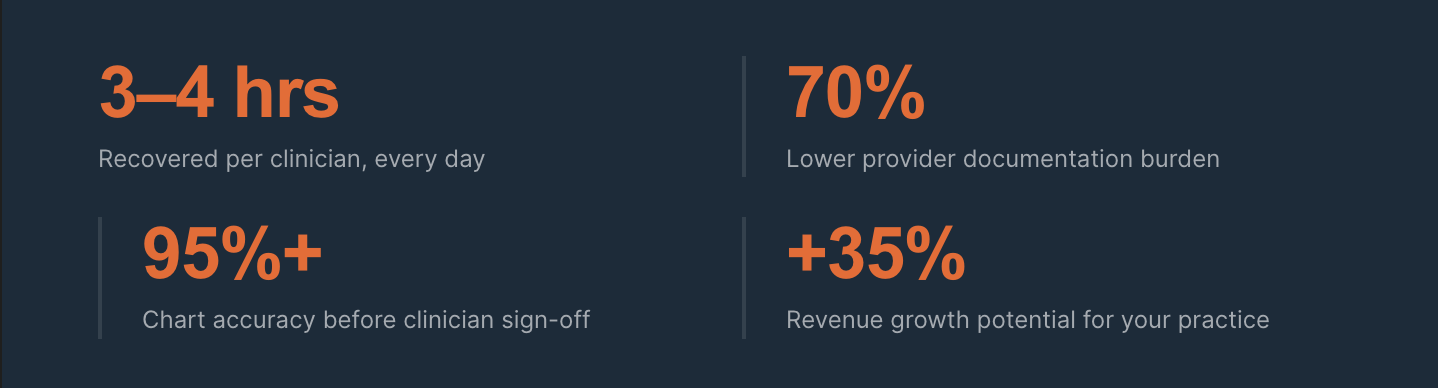
WoundScribe enables clinicians to see an average of 3–4 additional patients per day by streamlining time-consuming workflows.
Without WoundScribe
With WoundScribe
A Day in the Field — Transformed
From First Stop to Last,
AI Is Working With You
WoundScribe on Wheels fits into your existing workflow at every moment — without adding a single extra step.
-
Point your phone at the wound. WoundScribe's AI automatically detects wound borders, measures dimensions with clinical precision, and generates a comprehensive wound description — all in seconds. No ruler. No manual entry. Defensible documentation at every visit.
-
As you assess the patient and speak with facility staff, the Scribe AI Agent listens in the background. No stopping to type. No dictating notes. The full clinical encounter is captured as it happens — naturally, completely, accurately.
-
While you drive to your next stop, WoundScribe is working. SOAP notes, procedure notes, visit summaries, and coding are being drafted in the background from the imaging and encounter data. Your next chart is already in progress before you arrive.
-
When you close your last visit, your charts are drafted, organized, coded, and ready for a quick review. What used to take 2–3 hours takes minutes. Go home on time. Come back tomorrow with energy left to give.
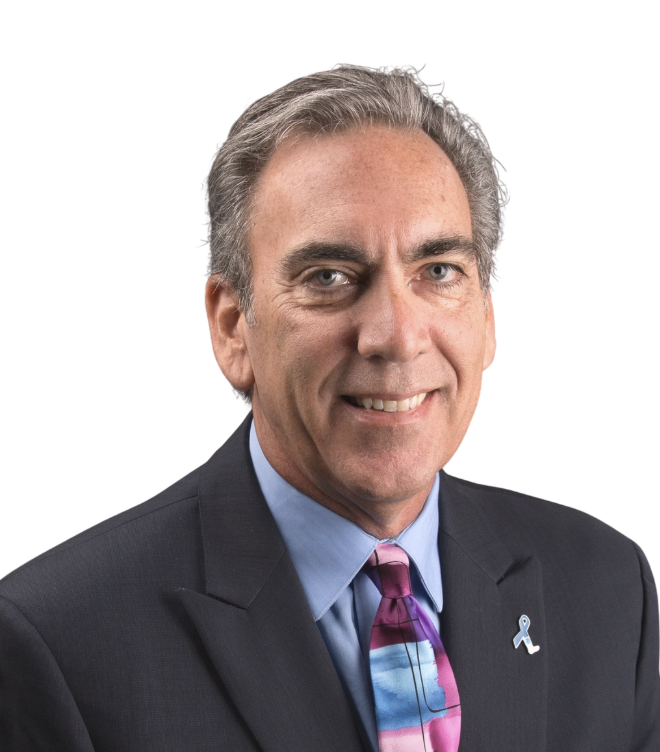
“I spent years doing exactly what mobile wound care companies are doing today — delivering excellent clinical care while fighting the documentation, billing, and operational challenges that come with working in the field.
WoundScribe on Wheels is what I wish I had in 2003. It gives mobile providers the infrastructure to do what they do best: get to the patient, deliver great care, and let the platform handle everything else.”
— Dr. Desmond Bell, DPM
Founder of the first Mobile Wound Care Service, USA, 2003
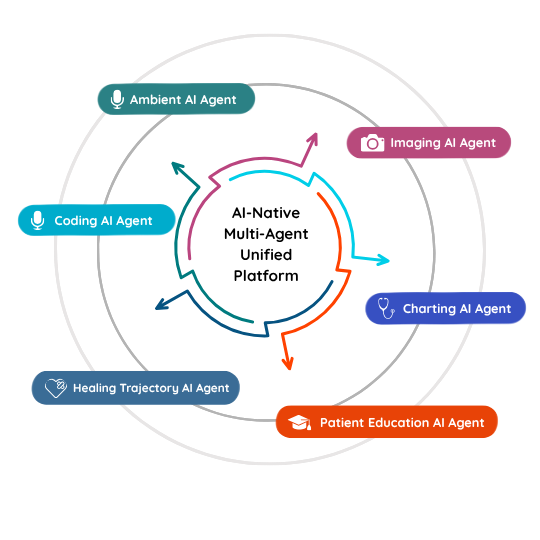
Six AI Agents.
One Integrated System.
Each agent solves a specific barrier that has historically limited mobile wound care at scale. Together, they replace a dozen fragmented tools with one seamless platform built for the field.
Ambient AI Agent
No need to type as you talk or try to remember the conversation with the patient. Ambient AI Agent captures the full conversation, or you can dictate a summary of the encounter. Ambient AI agent not only transcribes the conversation but also detects the speakers, filters out side conversations and greetings, creating a clean output for analysis and charting.
Imaging AI Agent
Point-n-Capture technology detects wound borders, measures dimensions using planimetry, and generates wound descriptions, all from your smartphone. No need to place a calbration marker next to the wound. Consistent, objective documentation across every clinician on your team.
Healing Trajectory AI Agent
AI-driven recommendations drawn from thousands of wound care cases, based on established guidelines and most advanced research findings. Faster, more consistent treatment decisions — regardless of prior clinical experience, practice setting, or place of service.
Charting AI Agent
Transforms raw assessments into complete, audit-ready clinical notes that flow directly into your EHR — saving hours of documentation per shift.
Coding AI Agent
Auto-suggests accurate ICD-10, CPT, and HCPCS codes from your wound documentation — maximizing reimbursement and eliminating coding backlogs.
Patient Education AI Agent
Delivers personalized, evidence-based wound care guidance to patients in plain language. Let's them test their knowledge, ask questions, and understand what they need to do to fast-track healing. — boosting adherence and outcomes between visits.
Built by clinicians for clinicians.
Our president, Dr. Desmond Bell, DPM, CWS, founded the first mobile wound care service in the US in 2003. Our CMO, Dr. Lucian Feraru, DPM, is an active podiatrist who uses these same workflows daily. Our research — including two PubMed-indexed papers on diabetic foot ulcers — is co-authored with Dr. David G. Armstrong, the most-cited podiatrist in the world. When we say this platform understands a debridement note, it's because the people who built it have written thousands of them.